Months away and the fibre still holds the address.
There is an assumption that training consistency is binary: you are either training and accruing benefit, or you are not training and losing everything you worked for. Understanding the first law of thermodynamics however invites more questions. Looking beyond the visible changes when exercising for the first time: the clothes that fit differently, the resting heart rate that drops, the posture that shifts; something more durable is happening at the cellular level. A structural change that does not reverse quite easily when training stops. While it is agreed that consistent workout is required for continued benefits, the brighter side is you do not need to start from scratch every time you renew your consistency vows. I will explain how, using transfer learning, a concept in building artificial intelligence.
When a neural network trains on a large dataset over a long period, it develops internal mappings as weights that represent learnt patterns. Early layers learn to detect edges, middle layers learn shapes and spatial relationships, and deeper layers learn intricate abstractions. When training stops, those weights do not change or decay. The learning is retained and structurally persists in the parameters. They have become encoded. When the model is applied to a new but related task and training on data resumes, the network starts from a position of accumulated structure rather than from scratch. A new neural network given the same task must discover everything from the beginning. The pre-trained network is already most of the way there. This process is where the GPT acronym gets its name: generative pre-trained transformer. From that foundation it can be fine-tuned for other use cases.
When the body begins training for the first time, two systems build in parallel. Muscle tissue responds to load by integrating new nuclei: myonuclei that fuse into the muscle fibre. These nuclei are the administrative infrastructure for muscle growth, coordinating protein synthesis from within the fibre itself. Simultaneously, the nervous system begins encoding movement: the motor cortex writes sequences of neural firing that coordinate how muscles recruit, how force distributes, how timing lands. Repetition tightens the loop until what felt effortful becomes automatic. Both systems accumulate slowly, across months to years of consistent work.
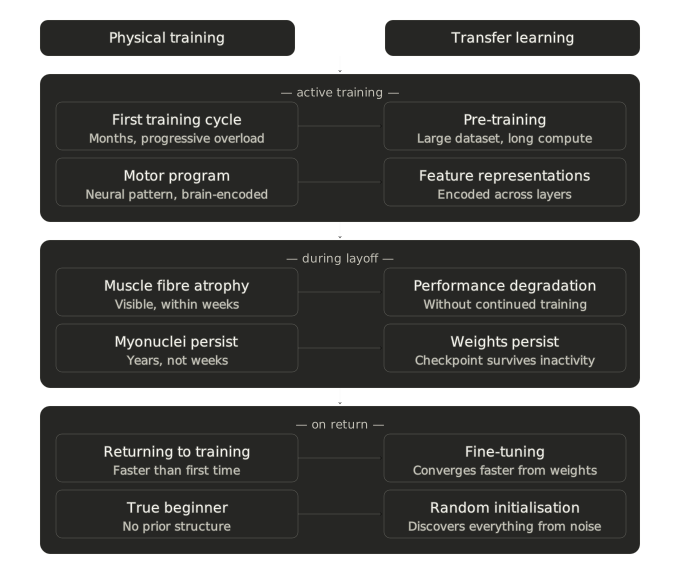
When training stops, the two systems decay on different schedules. The motor program weakens with disuse as unreinforced movements lose precision and movement quality softens. Muscle fibres atrophy visibly within weeks as protein synthesis drops. The myonuclei however persist inside the fibre for months, likely years, sitting idle but structurally present.
When training resumes, both systems reactivate from a non-zero position. The myonuclei resume coordinating protein synthesis almost immediately, allowing the fibre to re-expand into a domain that already exists rather than construct one from scratch. The motor program re-expresses within days, before the tissue has had time to rebuild, because the neural trace was never erased. A true beginner at the same strength level is writing both systems for the first time. The returning athlete is resuming from a checkpoint the body kept without being asked to.
The motor program is more volatile than the myonuclear side in the short term. A trained athlete who stops for six months loses movement precision faster than myonuclei. The brain’s representations require active maintenance. The muscle’s infrastructure does not. Two systems, two decay rates, and both faster than the rate at which they were originally built. This is why the return is forgiving, but the window is real and finite.
Consistency remains the requirement for continued adaptation. What transfer learning reveals is that the body honours prior work in ways that outlast the interruption. The architecture survives the absence. The return is a resumption from a checkpoint the body kept without being asked to.