Borrowed instructions, feedback, then patterns you no longer have to think about.
An observation in the history of scientific discovery is how one breakthrough is often followed by another that reshapes or even negates it. It reveals how open-ended discovery is. Physical training has not fully absorbed this idea. What generally works tends to be repeated, even when individual environments differ. This is not inherently wrong; it is a necessary starting point for mastering strength and movement.
In physical training, most people move through three phases without naming them. It begins with rules borrowed from others, shifts into personal experimentation shaped by individual conditions, and eventually settles into a quiet understanding of what works, when it works, and why. Subtle pattern recognition. This progression mirrors how artificial intelligence systems learn, and it provides a useful structure for understanding the learning transitions that happen in physical training.
The earliest approach to teaching machines was supervised learning. It relies on human-provided rules. Inputs are paired with correct outputs by someone who already understands the data. The model makes predictions, measures its error, and adjusts.
This is what happens when you first enter the gym.
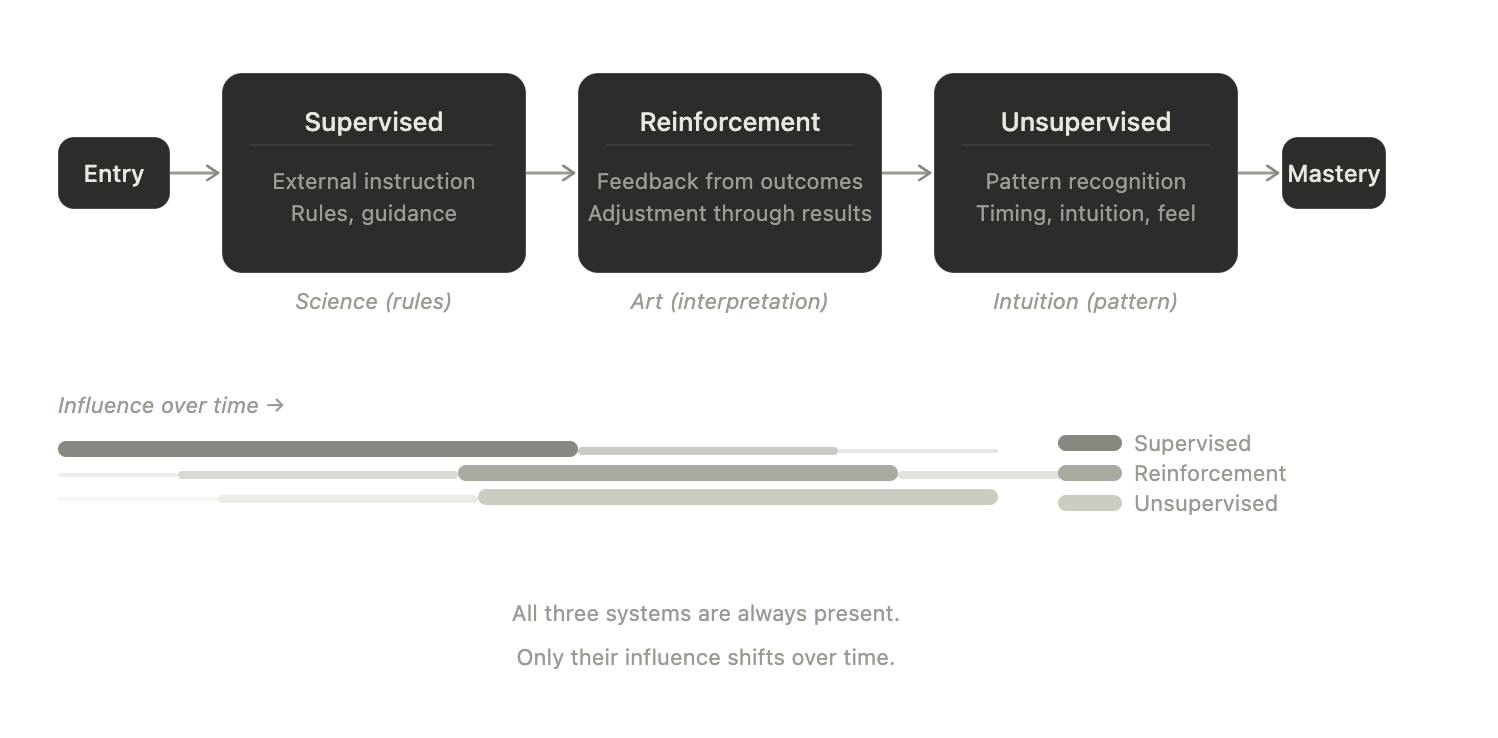
You arrive with borrowed knowledge. Someone else’s programme. Someone else’s logic about what the body needs and how it responds. You follow incline treadmill protocols because a fitness account said it targets lower belly fat. You increase protein because research supports it. You avoid skipping workouts because consistency is prescribed. Training here is a science of instruction. Rules are followed, variables are controlled, and outcomes are expected to align with theory.
This phase is not wrong; in fact, it is necessary. These rules worked under controlled conditions and serve as the only map available to someone who has never entered the territory. The body absorbs structure it does not yet have the experience to question.
Reinforcement learning is the second phase. It is a reward-based system where an agent learns from its environment through feedback. In training, your body is the agent. The environment is your gym, nutrition, sleep, and the stimulus you apply. The feedback is the outcome of those interactions. The shift into this phase is gradual. The rules begin to feel misaligned: a programme prescribes three sessions per week, but your recovery takes longer. A protocol suggests a fixed intensity, but your energy system responds differently. You begin to adjust and discover patterns that no programme could have prescribed because they are specific to you.
This is where training stops behaving like science and begins to feel like art.
Unsupervised learning is the final phase. It has no teacher and no explicit reward signal. It identifies patterns within data by exposure. In training, the data is accumulated experience: past outcomes, repeated conditions, subtle shifts in performance. Over time, what works, when it works, and in what conditions it works becomes understood without deliberate analysis. Patterns surface and decisions become immediate. The distinction between knowing and doing begins to dissolve. What once required conscious adjustment becomes automatic, often called intuition, but it is the result of prolonged exposure, not instinct.
Rules get you started because you need a map before you can learn the territory. Feedback takes you further because the territory is always more specific than the map. Patterns carry you to a point where knowledge no longer needs to be verbalised to be applied. In the end, all three phases describe the same movement: the body learning to recognise itself. No two bodies produce identical outcomes under identical conditions.
Training begins with instruction, evolves through feedback, and ends in intuition.